
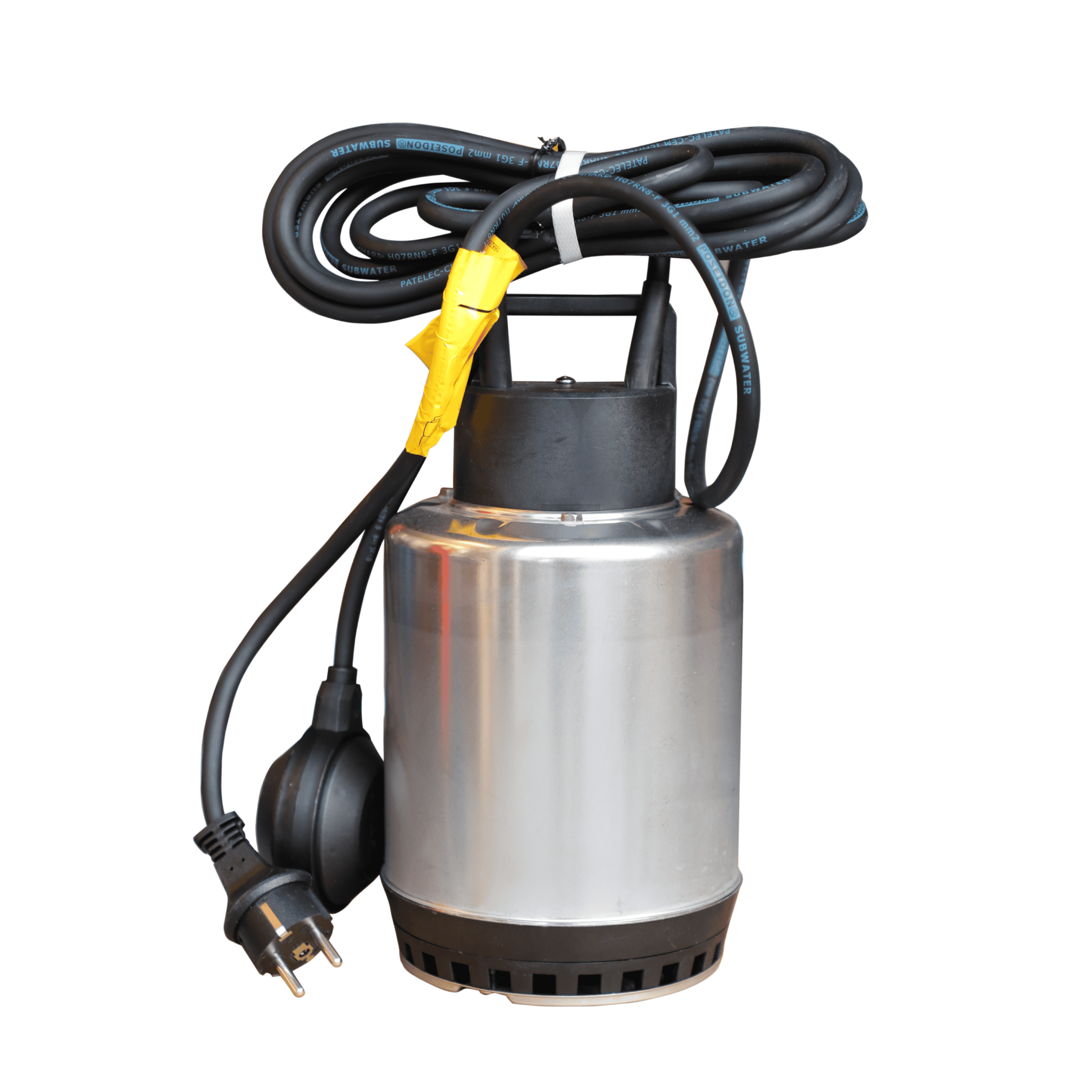

1 HP and 1.5 HP submersible pumps are the sizes most often asked about for villas, farms and small drainage jobs. Prices vary widely between brands and specifications, and the cheapest pump is often not the best value. This guide explains what affects the price and how to choose the right size.
What 1 HP and 1.5 HP mean
HP (horsepower) is the motor’s power rating. 1 HP is about 0.75 kW and 1.5 HP is about 1.1 kW. Motor power alone does not tell you what the pump can do. Two 1 HP pumps can deliver very different flows and heads depending on their hydraulic design.
What matters is the duty point: the flow the pump delivers at the head your installation requires. Always check this on the pump curve.
What affects the price
Pump type. Borewell pumps (slim 4 inch multistage pumps) are built differently from drainage pumps and cost differently. Sewage pumps with vortex or cutter impellers cost more than clear water pumps of the same power.
Materials. Stainless steel bodies and impellers resist corrosion and sand better than plastic or cast iron. For brackish groundwater common in UAE coastal areas, stainless steel is worth the extra cost.
Motor quality. Look for copper windings, suitable insulation class, and thermal protection. A cheaper motor may overheat in hot groundwater or under voltage fluctuations.
Single phase or three phase. Single phase pumps need a start capacitor and control box. Three phase pumps need a three phase supply but are generally more robust at larger sizes.
Cable length. Borewell pumps need a submersible cable long enough to reach the surface. Deep wells need longer and thicker cable, which adds to the cost.
Controls and protection. A float switch, dry-run protection relay or control panel adds to the price but protects the pump. Many pump failures come from dry running and voltage problems.
Brand and support. Established brands provide documented curves, spare parts and warranty support in the UAE.
How to know which size you need
You need two figures:
- Required flow, for example in litres per minute or m³/h.
- Total head: the vertical distance from the water level (when pumping) to the discharge point, plus losses in the riser pipe and pipework.
Example: a borewell with a pumping water level 30 m below ground, delivering to a ground-level tank 20 m away through 1.25 inch pipe, needing 2 m³/h. Total head might be around 35 m. Check the pump curves for a model that delivers 2 m³/h at 35 m near its best efficiency point. Depending on the hydraulic design, this could be a 1 HP or 1.5 HP pump.
If you choose by HP alone, you risk a pump that cannot lift high enough, or one that runs at the far end of its curve and wears quickly.
Questions to ask before buying
- What flow does the pump deliver at my head? Show me the curve.
- What are the pump and impeller made of?
- Is the motor suitable for the water temperature and quality?
- What protection is included against dry running and voltage faults?
- Are spare parts available locally?
- What does the warranty cover, and for how long?
Running costs
A 1.1 kW pump running 4 hours a day uses about 4.4 kWh a day. Running cost depends on the tariff, but a more efficient pump that is correctly sized can save more over its life than the difference in purchase price.
Frequently asked questions
Is a 1.5 HP pump always better than a 1 HP pump?
No. A larger pump that is oversized for the job wastes energy and may cause problems such as drawing down the well too far. Choose by duty point, not by HP.
How long does a submersible pump last?
It depends on water quality, sand content, running hours and protection. See how long does a water pump last.
Can I use a borewell pump for drainage?
Borewell pumps are designed for clean water in a well casing. For drainage of dirty water, use a drainage or sewage pump.
Next step
See our submersible pumps or send your well depth, water level and required flow to Lifeline for a selection and quotation.