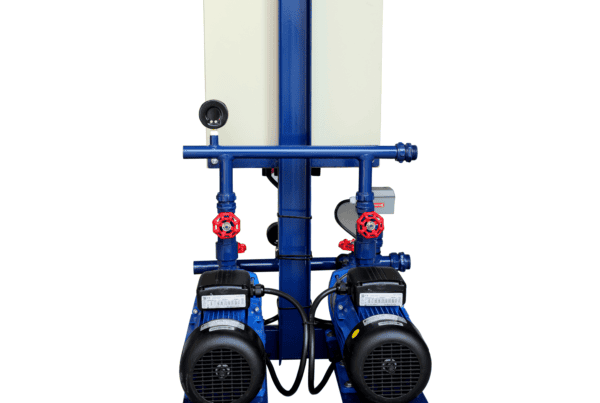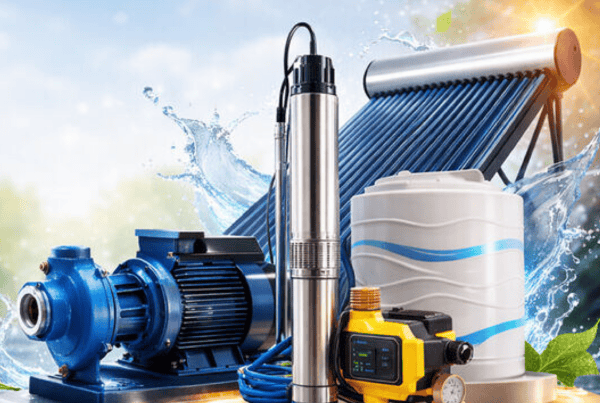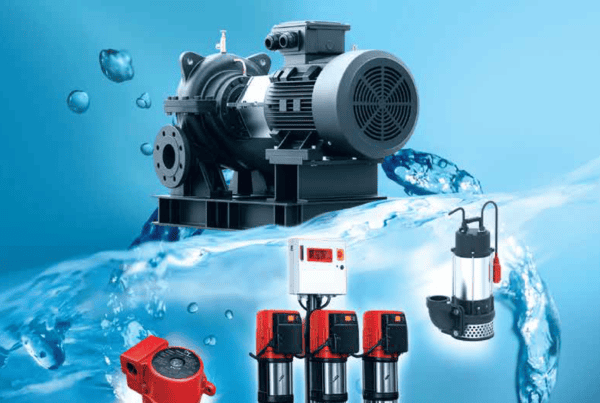

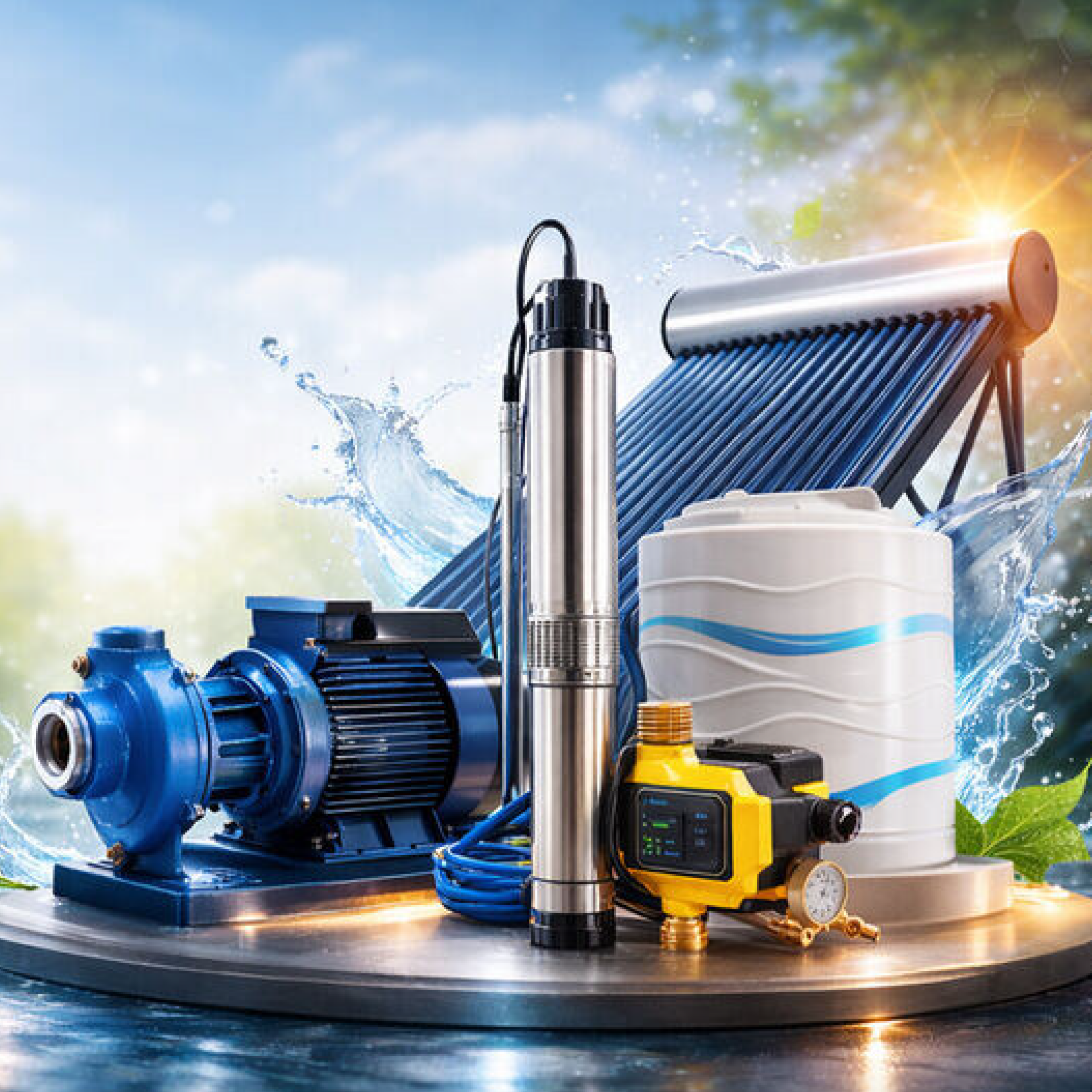

A centrifugal pump is a pump that uses a rotating impeller to move liquid. It is the most widely used pump type in water supply, building services and industry, from small domestic pressure pumps to the large pumps in district cooling plants.
The working principle
A centrifugal pump converts the rotational energy of a motor into energy in the water, in two stages:
- The impeller adds velocity. Water enters the centre (eye) of the spinning impeller. The curved vanes push the water outward, and it leaves the impeller tip at high speed.
- The casing converts velocity into pressure. The pump casing, usually a spiral-shaped volute, gradually widens. As the water slows down in the volute, its velocity energy becomes pressure energy, and the water leaves the discharge at higher pressure.
As water leaves the eye of the impeller, a low-pressure zone forms there, which draws more water into the pump from the suction pipe. The process is continuous, so flow is smooth and steady.
Main parts
- Impeller: the rotating part with vanes. It can be closed (shrouded on both sides), semi-open or open, depending on the liquid.
- Casing or volute: collects water from the impeller and converts velocity to pressure.
- Shaft: connects the impeller to the motor.
- Mechanical seal or gland packing: stops water leaking where the shaft passes through the casing.
- Bearings: support the shaft.
- Motor: usually an electric induction motor, close-coupled or connected by a coupling.
Types of centrifugal pump
- End suction: water enters along the shaft line and leaves at the top. General purpose.
- Inline: suction and discharge on the same line. Compact, common in HVAC.
- Split case: casing splits for maintenance. Used for high flows.
- Multistage: several impellers in series for high pressure. Used in booster sets.
- Submersible: pump and motor sealed for use under water.
The pump curve
Every centrifugal pump has a performance curve showing the head it produces at each flow rate. As flow increases, head falls. The curve also shows efficiency, power and NPSH required.
The point where the pump curve crosses the system curve (the head the system needs at each flow) is the operating point. A well-selected pump operates close to its best efficiency point (BEP), where efficiency is highest and vibration and wear are lowest.
You can change the operating point by:
- Throttling a valve, which wastes energy
- Trimming the impeller, a permanent change
- Changing speed with a VFD, which is the most efficient method
Affinity laws
When a centrifugal pump’s speed changes:
- Flow changes in proportion to speed
- Head changes with the square of speed
- Power changes with the cube of speed
So a pump running at 80% speed delivers 80% of the flow, 64% of the head and uses about 51% of the power. This is why VFDs save so much energy on systems that run at part load.
Priming
Most centrifugal pumps cannot pump air. The pump casing and suction pipe must be full of water before starting. Pumps installed below the water level (flooded suction) prime themselves. Pumps above the water need a foot valve or a self-priming design.
Where centrifugal pumps are used
- Water transfer and booster sets in buildings
- Chilled water and condenser water in HVAC
- Irrigation and landscaping
- Feed pumps for RO and filtration plants
- Process cooling and industrial water
Centrifugal vs positive displacement pumps
Centrifugal pumps suit high flows of low-viscosity liquids such as water. Positive displacement pumps (piston, diaphragm, gear) suit low flows at high pressure, viscous liquids and accurate dosing. See positive displacement vs centrifugal pumps.
Frequently asked questions
Why is it called a centrifugal pump?
Because the impeller throws water outward from the centre, the same direction as centrifugal force.
Can a centrifugal pump run with the discharge valve closed?
Only briefly. With no flow, the energy goes into heating the water, which can damage the seal and pump.
What causes noise in a centrifugal pump?
Common causes are cavitation, worn bearings, misalignment and running far from the best efficiency point. See pump cavitation.
Next step
See our range of centrifugal pumps or contact Lifeline for a selection.